
Madhya Pradesh Loses 149 Leopards in 14 Months, RTI Data Reveals
Authored by boxingbettingnow.com, 15-04-2026
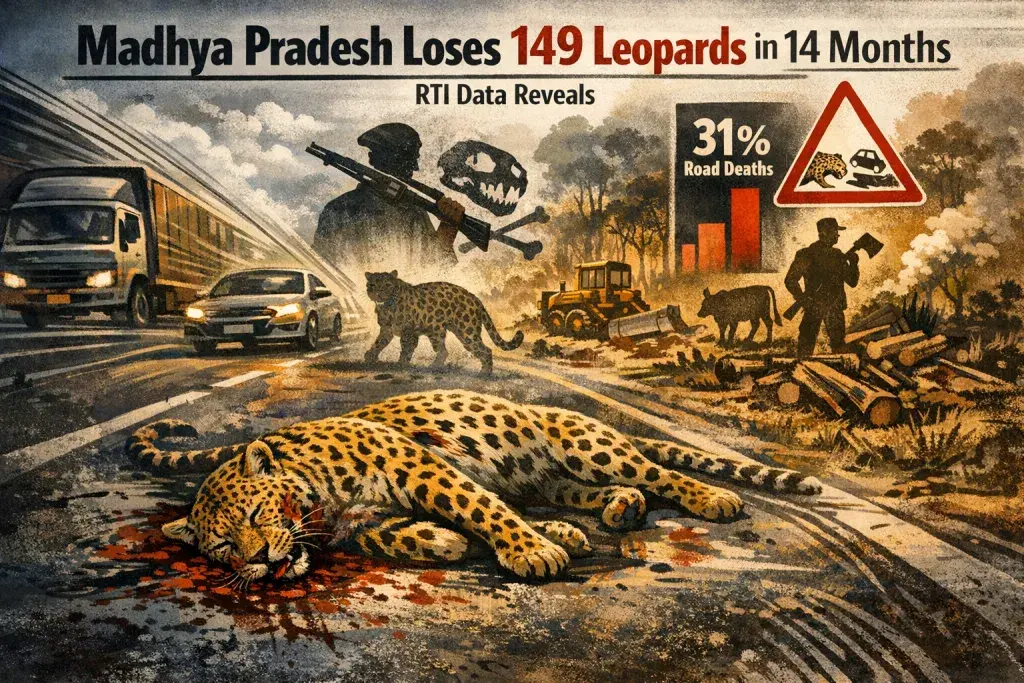
One hundred and forty-nine leopards died in Madhya Pradesh between January 2025 and the following fourteen months — a figure that conservation activists say reflects a deepening crisis for one of India's most ecologically significant big cats. The data, obtained through a Right to Information query filed by activist Ajay Dube, has drawn sharp scrutiny toward the state's wildlife management practices and the mounting pressures facing leopard populations across central India.
Road Accidents Drive the Highest Share of Deaths
The Forest Department's own figures place road accidents at the top of the mortality list, accounting for 31 percent of all deaths. Of those, 19 occurred on highways — fast-moving corridors that cut through or run adjacent to forest land and buffer zones where leopards routinely move in search of prey and territory. This pattern is not unique to Madhya Pradesh. Across India, the expansion of road infrastructure without adequate wildlife crossings or speed mitigation has made highways among the most lethal forces facing large terrestrial mammals. Leopards, which are adaptable and often range into semi-urban and agricultural edges of forest land, are particularly exposed to vehicle collisions.
The state government has acknowledged the problem and stated that efforts are underway to reduce fatalities, though no specific measures were detailed in the RTI response. Officials also noted that a four percent mortality rate falls within what they describe as acceptable limits — a framing that Dube and other observers have challenged as inadequate given the absolute numbers involved and the species' broader vulnerability.
Why the "Acceptable Limit" Argument Deserves Scrutiny
The claim that a four percent mortality rate is within acceptable bounds requires context to evaluate properly. Population viability depends not only on the percentage of animals lost but on the size of the breeding population, the sex and age composition of those dying, and whether deaths are being offset by successful reproduction. If a disproportionate number of fatalities involve adult females or sub-adults not yet counted in formal surveys, the actual demographic impact could be significantly worse than aggregate percentages suggest. Wildlife managers worldwide use mortality thresholds as planning tools, but those thresholds are only meaningful when applied to accurate, regularly updated population estimates — data that India's big cat monitoring has historically struggled to produce with full precision.
Madhya Pradesh has long been considered a stronghold for both tigers and leopards, hosting multiple protected areas including several Tiger Reserves where leopard populations also persist. Leopards, however, receive far less systematic monitoring than tigers. They are not subject to the same formal census processes, which means their population baselines are less certain — and that uncertainty makes percentage-based mortality claims difficult to assess with confidence.
The Broader Pressure on Leopard Survival
Beyond road deaths, leopards in Madhya Pradesh — as across much of their Indian range — face a converging set of threats. Human-leopard conflict, retaliatory killings following attacks on livestock or people, poaching for the illegal wildlife trade, and habitat fragmentation driven by infrastructure and agricultural encroachment all contribute to a precarious situation. Leopards are listed as Vulnerable on the IUCN Red List globally, though Indian populations are protected under Schedule I of the Wildlife Protection Act, 1972, the country's highest legal safeguard for wildlife.
The RTI mechanism itself deserves recognition here. That such data came to public attention through a citizen's formal information request — rather than through proactive government disclosure — points to a transparency gap in how wildlife mortality data is communicated. Dube's filing has effectively placed the issue on record and made it available for public and policy debate. Conservation outcomes in democratic systems often depend on precisely this kind of information access.
What Meaningful Action Would Require
Reducing leopard mortality at this scale demands more than incremental adjustments. Effective interventions would include installing underpasses or overpasses at documented high-risk highway crossings, enforcing speed limits in zones identified as wildlife movement corridors, and expanding real-time mortality surveillance so that deaths are recorded, mapped, and acted upon rather than compiled only in response to RTI queries. Equally important is a credible, publicly accessible population estimate that would allow mortality figures to be interpreted with genuine scientific rigour rather than administrative convenience.
Fourteen months. One hundred and forty-nine animals. For a species that occupies the same ecological space as India's most celebrated conservation story, the leopard's quiet attrition deserves an equally serious policy response.